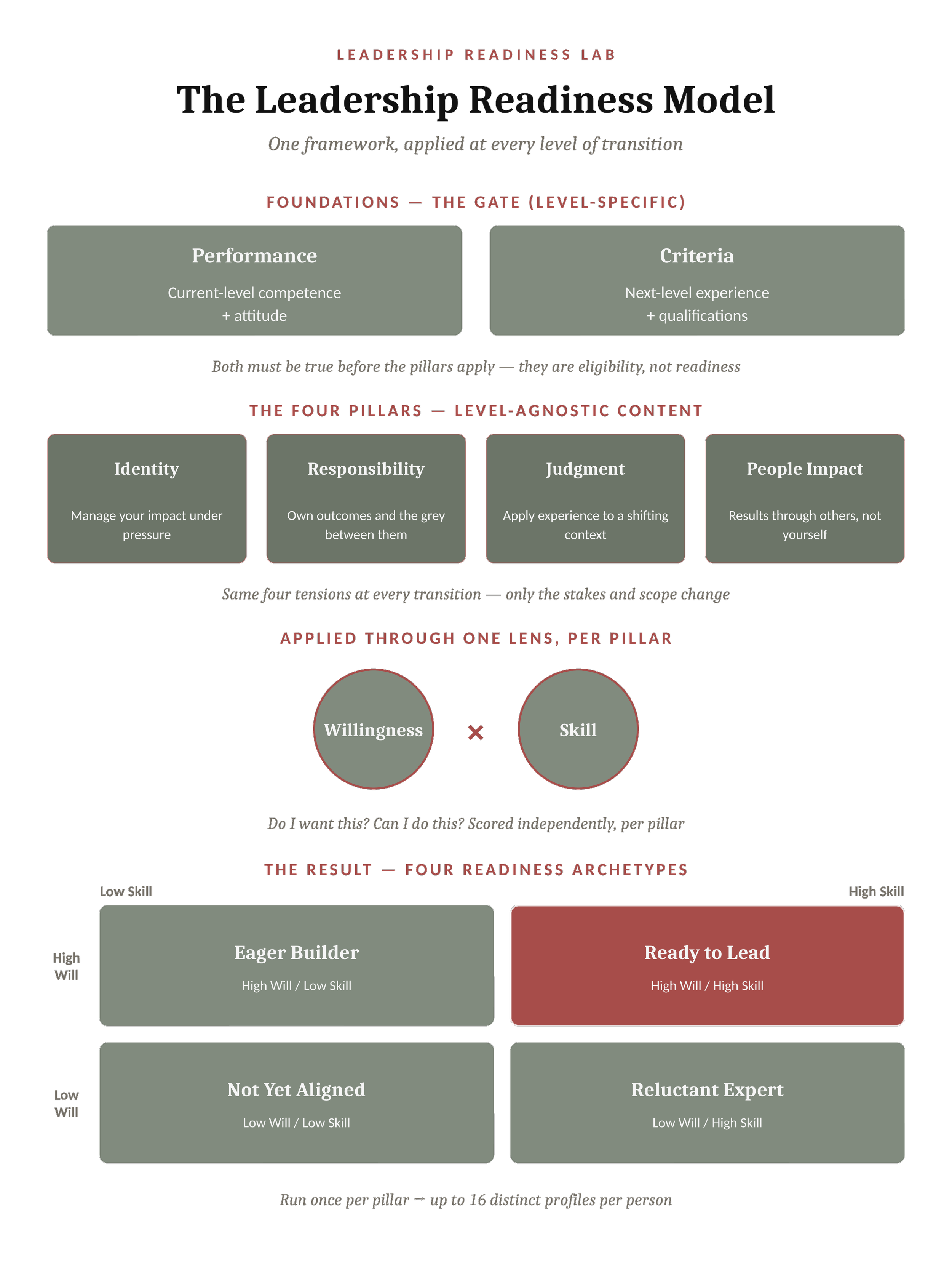
Section 1 — Foundations: The Gate
Before the pillars apply, you have to clear the gat. Every level of leadership has its own entry requirements. Before readiness even becomes a relevant question, two things have to be true:
Performance — Current-level competence, plus the attitude to match.
Criteria — The next level's experience and qualifications.
Both must be true before the pillars below apply. Clearing the gate makes you eligible. It doesn't make you ready, that's what the rest of the model measures.
Section 2 — The Four Pillars
The same four tensions, at every level
Once you're eligible, readiness comes down to four pillars. They don't change as you move up, only the stakes and the scope do.
Identity — Manage your impact under pressure.
Responsibility — Own outcomes and the grey between them.
Judgment — Apply experience to a shifting context.
People Impact — Deliver results through others, not yourself.
See how each pillar shows up, and where leaders typically derail
Section 3 — The Lens: Willingness × Skill
Applied through one lens, per pillar
For each of the four pillars, I ask two separate questions:
Willingness — Do you really want this, at this level? Skill — Can you do this, at this level?
They're scored independently, because they answer different problems. Skill without willingness looks like resistance. Willingness without skill looks like overreach. You need both, pillar by pillar, to call it readiness.
Section 4 — The Result: Four Readiness Archetypes
Where you land, and what it means
Run the lens against a pillar and you land in one of four places:
Ready to Lead (High Will / High Skill) — The pillar isn't a risk. You have both the capability and the appetite for what this level demands.
Eager Builder (High Will / Low Skill) — The willingness is there; the capability isn't yet. This is a development gap, not a character gap — and it's the fastest one to close.
Reluctant Expert (Low Will / High Skill) — You can do it. You may not want to. Worth asking honestly why — because unaddressed, this is where capable people quietly stall.
Not Yet Aligned (Low Will / Low Skill) — Neither the appetite nor the capability is there yet. Not a verdict — a signal that this pillar needs real attention before the next step.
Because this runs once per pillar, most leaders don't land in just one archetype — they land in up to four different ones at once. That's the point. Readiness isn't one number. It's a profile.
The Leadership Readiness Model
A Framework for Every Leadership Transition. One framework. Every level of transition.
Most leadership frameworks describe what good leadership looks like. This one does something different: it tells you whether you're ready for it.
Readiness isn't a single score. It's not pass or fail. It's a combination of two gates and four pillars, each one scored on its own terms — because a leader can be more than ready in one area and not yet ready in another, and knowing the difference is the whole point.
Here's how it works.
Ready to Lead
✳︎
Eager Builder
✳︎
Reluctant Expert
✳︎
Not Yet Aligned
✳︎
Ready to Lead ✳︎ Eager Builder ✳︎ Reluctant Expert ✳︎ Not Yet Aligned ✳︎
Know where you actually stand. The Leadership Readiness Diagnostic™ walks you through this exact model, the gate, the four pillars, the willingness-and-skill lens, so you can see your own readiness profile, not just take our word for it.
Five modules. One clear path forward. This self-guided system takes you from honest self-assessment to a prioritised development plan, your specific readiness gaps, pillar by pillar, and a 90-day roadmap. For leaders who want their next move built on evidence, not just ambition.
Who it's for
You know the Four Pillars; Responsibility, Judgment, People Impact, Identity, maybe from the Diagnostic, maybe from your own experience. What you don't have yet is proof of where you actually stand on each one, or a plan for closing the gap. This is for leaders who'd rather spend 90 days building evidence than another year hoping the next promotion sorts itself out.
What you get
Five modules, 90 days, entirely at your own pace. One pillar every 18 days, plus a final module to bring it all together.
Theory and a real example, every module. The research behind why the pattern matters, and a realistic case of it playing out, so it's never abstract.
A proper self-assessment. Willingness and Skill, scored separately, placing you in one of four readiness quadrants per pillar, not a vague gut check.
Three practice activities per module. Built to build the habit, not just explain it, spaced across the module so the pattern actually has time to shift.
Journal prompts and a module checkpoint. So you're not guessing whether you're ready to move on.
A prioritised 90-day roadmap. Every pillar, one page, with your specific action, target date, and success marker.
What changes by day 90
This is the part most self-paced guides skip. Here's what you leave with:
You know your actual growth edge. Not a guess, a scored result across all four pillars that tells you exactly where you're Ready to Lead and where you're Not Yet Aligned.
You have a documented pattern, in your own words. From the Ownership Audit, the Decision Autopsy, the Advocacy Map, not a vague sense that something's off, but a named pattern with evidence behind it.
You've made a real call under real uncertainty and reviewed it. A time-bound decision, the assumptions behind it written down before you knew if you were right.
You've had the conversation you'd been avoiding. Not scheduled it, had it.
You've caught your default pattern live, at least once. Mid-meeting, mid-pressure, not just recognized it afterward, in hindsight.
You walk away with a plan, not a to-do list. A specific action, a target date, and a success marker for every pillar, ready to act on alone, or bring into a coaching conversation or the Accelerator.
Close
You don't need another assessment. You need 90 days of evidence about where you actually stand and what to do next. That's the Development Guide.

One team member. Four pillars. One honest conversation. A practical framework for managers deciding who's ready for the next role, what to look for, what to assign, and how to have the conversation when it's time. Built on the same Leadership Readiness Map™ behind the Diagnostic, Report, and Development Guide.
Who it's for
You already see it every day, how they handle ambiguity, whether they own outcomes or hand them back, how they treat people with less power than them. What you don't have is language for it. This is for managers who have someone asking about promotion, or a promotion decision to make, and don't want "strong performer" to be the whole rationale.
What you get
The Four Pillars, translated for managers. Identity, Responsibility, Judgment, People Impact; the same framework your team member would see in the Diagnostic, reframed around what you can observe.
Signals of readiness and common derailers, per pillar. Concrete behavior to watch for over weeks, not a single meeting.
Stretch work to assign, deliberately. Real tasks, an ownerless problem, a time-boxed ambiguous decision, a mentoring relationship, built to test and build each pillar, not busywork.
Coaching questions for your 1:1s. Built to grow their self-awareness, not just sharpen your assessment of them.
A framework for the Readiness Conversation itself. How to say "ready," "not yet," or "proceed with caution" and mean something specific by it.
A one-page quick reference. Signals and stretch work for all four pillars, side by side, built to keep open during 1:1s and performance conversations.
What changes after you use it
This is the part most manager toolkits skip. Here's what you leave with:
You can name it, pillar by pillar. Not "they're ready" or "they're not" which of the four is solid, and which specifically needs more time.
You've watched them handle something real. A stretch assignment you chose on purpose, debriefed on purpose not a guess based on how they present in meetings.
You have three honest answers, not two. Leadership Ready, Readiness in Development, or Proceed with Caution each with a reason attached, instead of a yes/no that either oversells or stalls someone unfairly.
If they're not ready yet, they don't leave empty-handed. One or two concrete stretch assignments tied to the specific pillar that needs work not "keep growing" with no shape to it.
You can defend the call. Behavior-based language ("stepped into that ownerless project and drove it to resolution") instead of potential-based language ("I think you'd be great") the difference when someone asks you why.
Close
You're already watching for this. This guide just gives you the language to turn what you're observing into a decision you can stand behind and a conversation that actually helps them get there.
Popular

Eight weeks. A small cohort. Real decisions. The Accelerator is for leaders who are done preparing and ready to build. Applied, behavioural development that changes how you lead under pressure, not just how you think about it.
Who it's for
You've already done the thinking. You know your gaps across the Framework: Responsibility, Judgment, People Impact, Identity, maybe from the Diagnostic, maybe from years of finding out the hard way. What you don't have is a room where you can practice the hard parts before they cost you something real.
What you get
8 weeks, one small cohort of 8. Not a webinar series. A working group of peers navigating the same level of complexity you are.
Live practice on real decisions. Bring the actual call you're stuck on. Work it in the room, not in a case study.
Structured accountability every week. Someone checking whether you did the thing, not just whether you understood it.
What changes by week 8
This is the part most programs skip. Here's what you leave with:
You make the call. A high-stakes decision under real uncertainty, made and defended, without waiting for a consensus that was never going to arrive.
You know your trigger. The specific pattern that derails you under pressure, named and caught in real time, not diagnosed after the damage is done.
You've had the conversation. The one you'd been avoiding, done directly, with someone in the room who can tell you if you actually pulled it off.
You have evidence, not just intent. A documented track record across all four pillars, the kind you can point to when you're being considered for the next role, not just a certificate that says you attended.
You stop feeling like the only one. Seven other leaders who've seen your blind spots and are still in your corner, long after week 8 ends.
Close
You don't need another framework. You need a room where the stakes are real enough to change how you actually lead. That's the Accelerator.

2025
New York
The Atlast Project →
“Communication was top-notch and the final outcome was even better than we imagined. A great experience all around.”
Former CustomerGet In Touch
If you're interested in working with us, complete the form with a few details about your project. We'll review your message and get back to you within 48 hours.